By Zulkifal Abbasi for Invisiblites
Once there was a time when people were not judged based on their ability to cope with life situations but on their courage in seeking the solution. They were evaluated by the power of their inner lives, by the simplicity of purpose and boldness with which they infused confusion with meaning. Masses did not develop civilizations, but by groups who were not willing to remain small.
The countries do not fail because of the failure of their economies or their weakening systems. They collapse when inner strength gets impaired-when the inner world is regarded as the source of threat and goodness is misconstrued with obeying the orders. The state of things Pakistan is presently in is not only political or even economic; it is more than philosophical. It is of a gradual and cautious dwindling of personal liberty and the silent forfeiture of real norms in favor of what is valuable.
This loss did not occur in a flash. It arrived within its time, gussied up in the name of order, unity, and necessity of all. Gradually, people were deprived of responsibilities, courage was not encouraged, and individual thinking was superseded by simply following others. What appeared was not someone who is informed by a great sense of right and wrong, but someone who simply survives.
Homo Creator and Homo Laborator
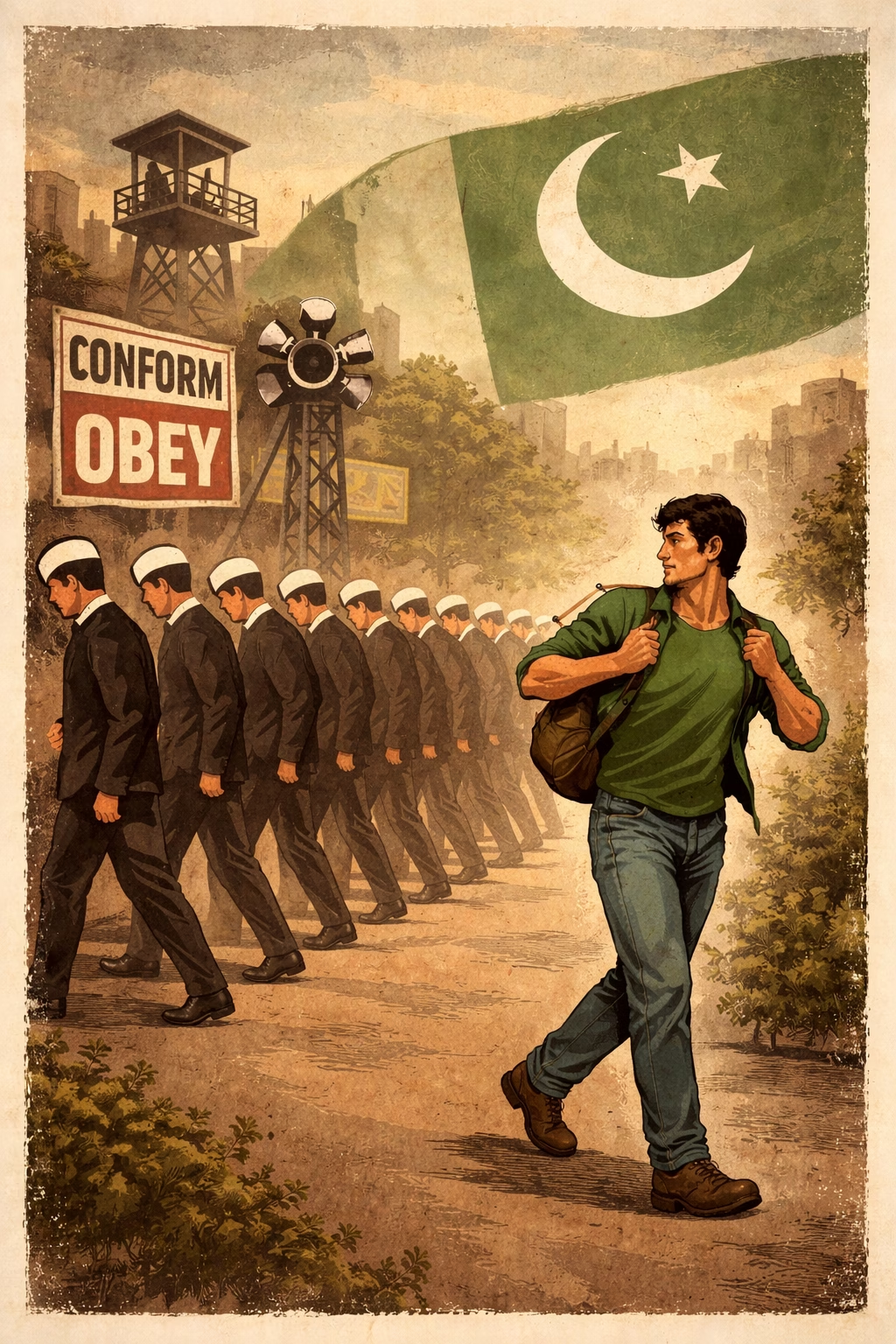
The core of this shift is a huge divide over what it means to be human: the distinction between those who make, and those who merely labor. The creator is impelled by enthusiasm – by passion, fantasy, and responsibility. He does not fit in life; he alters it. His meaning guides his work, and his struggle his purpose. Producing in this sense is not merely about how to make things but how to make a statement of who you are.
The worker lives in need. His existence is a repetition of things: work, spending things, becoming tired of them, and returning to the rut. Life does not run on coping with work. The survival being the utmost desire of a person weakens him or her in silence.
The perception that labor is the most suitable way of life characterizes our contemporary world, and more so, the case with Pakistan. The system does not seek individuals who are able to think and make decisions; it seeks employees who merely follow directions. Predictability is praised. Following rules is normal. The only thing accepted is being original as long as it does not cause trouble.
This change isn’t by accident. An individual who works independently cannot be easily controlled. He does not have to rely on borrowed thoughts. He does not succumb readily to catchphrases. The fact that his inner beliefs question outward authority makes him dangerous.
The Discipline of Survival
This situation is aggravated in Pakistan by economic problems. The fact that people are in a state of constant uncertainty implies that most people only worry about surviving. A busy man has no energy to think over larger matters because he has his food, shelter, and the basic needs to consider. In this sense, poverty is not just a misfortune: it is a lifestyle. The system works quite well. He is left to handle his life alone as a few individuals are given the reins of power and favors. It is not only that they are smart; it is because they are in the right places, which makes the rich get richer.
The poor are not assisted and are left to rely on their own devices, but are not far enough to remain self-sufficient. When individuals do succeed, it is a part of the group and the system that is celebrated. In case of failures, it is viewed as an individual failure and a moral weakness. The machine is harmonized, but its operator fails by himself. In the course of time, this results in feelings of guilt with no means of correcting it and doing what is right without believing in it.
Will Versus the Herd
In individuals, insanity is rare; but in groups, parties, nations and epochs, it is the rule.
Friedrich Nietzsche
Any system that attempts to govern people fears an individual who is going his own way. This type of individual does not seek the endorsement of the group. They do not allow figures to determine what is right. They raise themselves even at their own expense. This is why the side that attempts to be courageous, faithful, and imaginative is muted.
The heroism is not killed by a sword but made to look ridiculous and worn out. The desire to accomplish something great is regarded as pride. Honesty is perceived to be unrealistic. Being a strong value person is perceived as a threat; the crowd gets louder.
Individuals begin to believe that by simply agreeing, one is in effect knowing the truth. Thinking is replaced by feelings, and the novel individual voice is lost in the troupe. In such an environment, lunacy does not appear like anarchy, but rather like all are in consensus. The actual tragedy is not the fact that people do not strive to fight back, but that they arebconditioned to lose hope in the intention to fight back. The will to proceed is watered and modifiedbin such a way that ambition does not go high but simply attempts to get a guarantee, security, and acceptance.
The Loss of Action and Meaning
When individuals are in the capacity of a worker, something significant is lost – the very best action, the capacity to initiate something, effective speaking, and together altering the world. Work makes things. Labor keeps bodies alive. But deed changes the course of life.
It is not that Pakistan does not work hard enough, but it does not have a purpose. Its citizens strive, and yet, nothing endures. There is a repetition of institutions. Reforms simply put the words in another language. There is nothing new-nothing but under control. This is the cost of suppressing the individual, the hero in a man or a woman. Without creators, there is movement and no direction. The absence of morally-minded people makes order devoid of sense.
Conclusion: The Return to the Self
The collapse of Pakistan does not happen because it does not have smart, strong, and talented individuals. It is so because it has denied people the opportunity to develop themselves. A society that depreciates its members to workers can obtain labor but cannot elicit excellence. It is able to contain things within its reach, though it will have lost its soul.
Resurrection begins with new rules, but also a new way of thinking, not only with restoring the individual as the person capable of making moral decisions and creating. Not like a follower of the story or a mere producer, but one who can make decisions, accept responsibility, and develop. Pakistan will continue to squander its own people and puzzle why nothing endures until people are once again challenged to not only survive, but also to create something new, to investigate, and to soar even when all are staring the other way at them.
Zulkifal Abbasi is a final-year undergraduate student of Disaster Management at Government College University, Lahore. His academic interests include governance, risk assessment, and social structures in vulnerable contexts.
Photo credit: ChatGPT