By Jack Love for Invisiblites
Octavia Butler’s science fiction novel, Dawn, was published in 1987 as the first text in what would later be termed her Xenogenesis Trilogy. The plot of the novel follows a Black woman named Lilith as she grapples with leading a remnant of surviving humans after a global holocaust wipes out most of life on earth. Lilith is assisted by a mysterious alien species named the Oankali, who seek to aid humanity return to their home world. Dawn is unique because it takes place on board an alien spaceship. Within this estranging setting, Lilith has no choice but to learn about her alien captors.
As the novel progresses, Lilith begins to understand that Oankali assistance does not come without a price. The tentacled aliens seek to exchange genetic material with their human counterparts to enhance their own species’ superiority. Hence, Butler’s protagonist is thrust into a situation where she must mediate between the intimidating, strange aliens and the terrified humans whose lives have been preserved for a rather disturbing purpose. Where most of the other human characters in the book resist Oankali attempts to train and control them, Lilith halfheartedly complies with their demands. For this reason, she is elevated to humankind’s leader and shunned by her fellow captives.
Oankali aliens possess the unique ability to genetically alter living organisms. They alter plants, animals, and even other sentient beings to better survive and adapt in the expansive universe. The Oankali are essentially alien colonizers, and the alterations they enact on others is a subtle, understated violence. Understandably, Lilith and her fellow surviving humans are repulsed and even terrified by the Oankali plan for their species. Through the Oankali genetic trade system, Dawn critiques the idea of environmental conservation by suggesting that such projects frequently employ subtle forms of violence on the species being preserved.
When Lilith points out that the Oankali are essentially free to murder, sterilize, or degrade human beings for their own purposes, Kahguyaht assures her that they have never done such a thing. He says, “There was no life at all on your Earth when our ancestors left our original homeworld, and in all that time we’ve never done such a thing”. This is a common sentiment the Oankali express throughout the novel. They claim that they genetically alter species like human beings to help them survive. They are benevolent alien colonizers and, by extension, intergalactic conservationists. Yet, their intention to preserve both interferes with the natural course of events and inhibits the agency of other organisms.
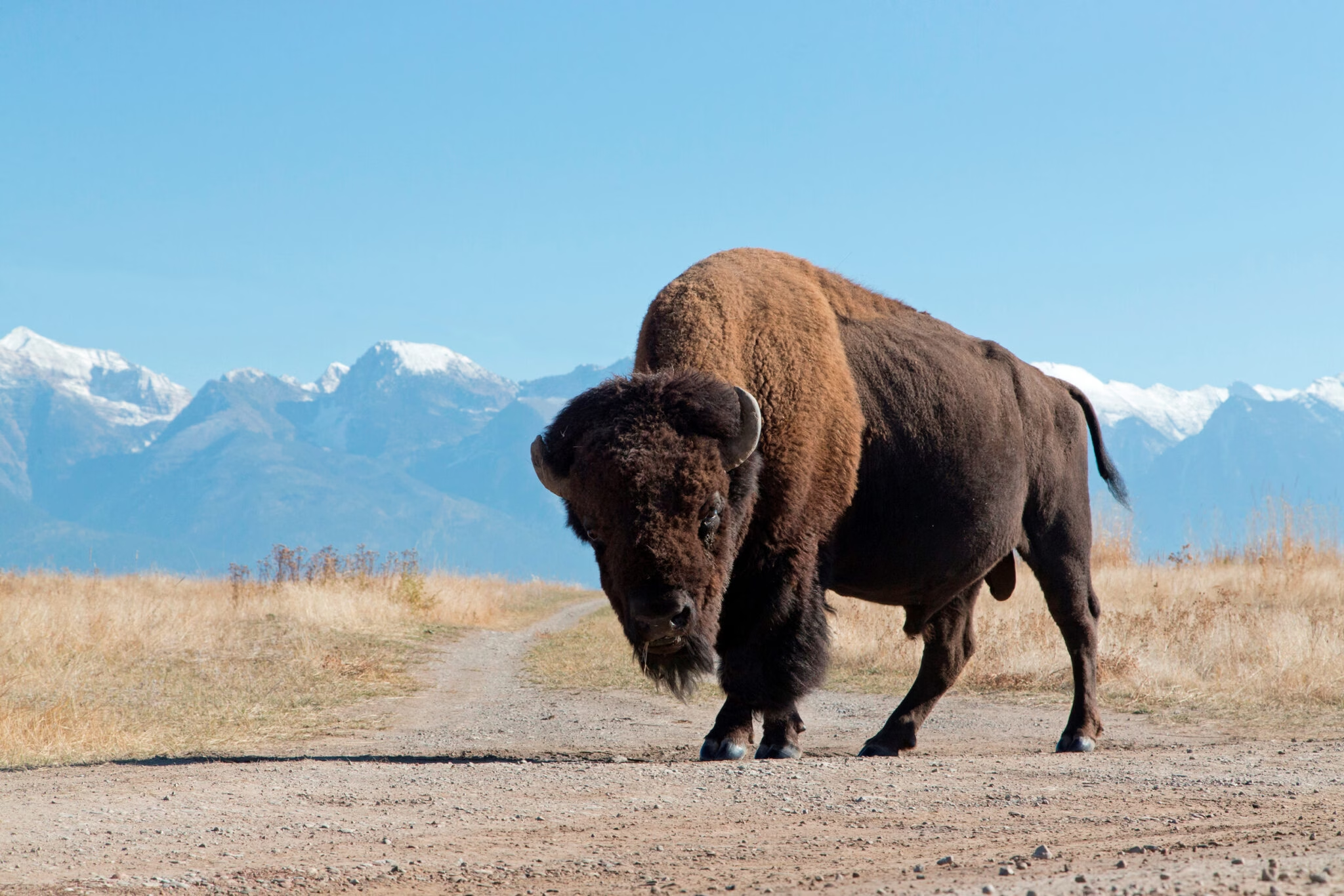
Looking at Dawn with ongoing conservation projects in North America and across the globe in general will shed further light on Butler’s critique. For instance, the Bison Restoration Project conducted by the American Prairie Foundation reveals the extent to which humans, particularly conservationists, distort animals to fit in their own idealized form of the landscape. While it is wonderful that the American Bison has been restored and repopulated, it does not come without a price. American Prairie’s website notes that most of the bison are “raised for commercial uses in herds on small acreages behind fences”. Accordingly, “these conditions threaten the genetic health of bison and greatly hinder their ability to roam widely and display natural behaviors”.
The incentive to save a species from near extinction stems from a purely human-centered motive. Most repopulated bison are mere commodities for human consumption. They become bison burgers or other novelty protein items for people around the world. While some can live as they “once were” before Anglo-American westward expansion of the 19th century decimated their numbers, it is only within the confines of naturally preserved places.
Yellowstone National Park in Wyoming, for example, holds thousands of bison who are free to roam. Yet, they can only roam within the confines of the preserved space. Thus, the animal is relegated to either serve as a commercial use or a tourist spectacle in one of the most popular national parks in the United States. What’s more, Yellowstone tourist locations serve bison meat for human consumption throughout the vast park. From this perspective, the conservation of the American Bison is underscored by anthropocentric violence. Like the humans in Dawn, endangered species are faced with extinction or the violence of preservation. Either way, endangerment often equals violence.
In Dawn, Octavia Butler displays conservation efforts in a new light. Imagine if humans were the ones being conserved by a more capable species. Imagine these alien species consistently asserted that they knew what was best for you and your fellow humans. Would you be okay with some paternal alien species dictating every choice you made, limiting your own freedom to choose? Through it all, you would realize – as Lilith and her fellow humans understand – that your choice, your agency, is hardly considered. In the end, you can either follow along with the Oankali’s plan or resist. Either scenario ends in violence. Through Dawn, Octavia Butler reminds us that environmental conservation is sometimes not as noble as it seems.
Jack Love is a writer, poet, and PhD Candidate currently working at Texas A&M. He has published creative writing in Gotham Literature, Dominique Lit Mag, Turtle Island Poetry, Fieldwren, Crow Line Literary, Livina Press, Educator’s Room and several others. He has published criticism in Atlantic Studies, Christianity & Literature, Pacific Coast Philology, Close Reading, American Book Review, and several other venues.
Photo credit: Inside Climate News